As temperatures drop, many parents wonder if their baby is warm enough. Babies lose heat faster than adults, but too much clothing can cause overheating, which is also unsafe. Finding the right balance can feel really tricky!
In my practice, I see this question come up every fall and winter. Parents often err on the side of over-bundling, which can trap moisture and heat, raising the risk of overheating, but underdressing can leave an infant unable to maintain their body temperature, especially in the first months of life when their thermoregulation system is still maturing.
In this article, you’ll learn how babies regulate temperature differently than adults, what kinds of fabrics and layers work best in cold weather, how to dress safely for sleep and car rides, and what signs indicate your baby might be too hot or too cold.
Why Babies Lose Heat Faster Than Adults
Newborns and young infants are particularly vulnerable to cold stress. Their small size and large body surface area mean they lose heat quickly – up to four times faster than adults (1). Babies, especially pre-term ones, also have less insulating fat and thinner skin, which makes temperature shifts happen rapidly (2).
Unlike adults, babies can’t easily adjust their temperature through behaviors like adding a layer or moving closer to warmth. Their bodies rely primarily on non-shivering thermogenesis, a metabolic process in brown adipose tissue that generates heat by burning fat (3). This mechanism is limited, making it really important for caregivers to help maintain a stable thermal environment externally.
One of the most effective (and beautiful) ways to support your baby’s temperature regulation is skin-to-skin contact. Holding your baby directly against your bare chest helps stabilize their body temperature, heart rate, and breathing rhythm (4). Research shows that a parent’s chest can warm or cool by several degrees to match the baby’s needs (5), acting as a built-in thermostat.
You might like this article, too: Can Cold Temperatures Make You Sick? The Real Reason Kids Get Sick More Often During Winter
How to Dress and Layer Your Baby for Winter
A good general rule of thumb is to dress your baby in one more layer than you would wear in the same setting.
If you’re comfortable in a long-sleeve shirt indoors, your baby likely needs a long-sleeve cotton onesie plus another cotton layer on top. If you’re bundled in a jacket outdoors, your baby probably needs a warm base layer, insulating layer, and outer layer for wind or moisture protection.
That said, there’s a limit to this rule. If it’s warm out, you don’t need to add an extra layer just because you’re wearing one. The “one more layer” guideline applies to cool or cold environments – not when the temperature is already comfortable or hot. Babies can overheat quickly, especially in warm weather or heated indoor spaces, so always use your baby’s comfort cues to guide you.
Here’s how to layer step-by-step:
1. Base Layer
This is the layer that touches your baby’s skin. Choose natural, breathable, moisture-wicking materials like:
- Cotton: soft, gentle, and breathable.
- Merino wool: excellent for regulating temperature and wicking away moisture (it keeps babies warm even when damp) – but pricey.
- Bamboo: lightweight and ideal for layering!
2. Middle Layer
Using the guideline of dressing your baby in one more layer than yourself, you’ll likely want to add this layer for most winter days. This layer helps trap heat. Depending on how cold it is, options include:
- Cotton footed sleeper for mild days
- Fleece or wool sleeper (or pants and a top) for colder environments
The goal is to create a stable thermal barrier without bulk.
3. Outer Layer: Weather Protection
When outdoors, your baby needs an outer layer that shields against wind and moisture.
- Bunting suits or zip up winter stroller blankets are ideal for stroller rides.
- For babywearing, use a carrier cover or parent jacket insert rather than heavy snowsuits (snowsuits in a carrier can be too restrictive of movement and hide signs of overheating)
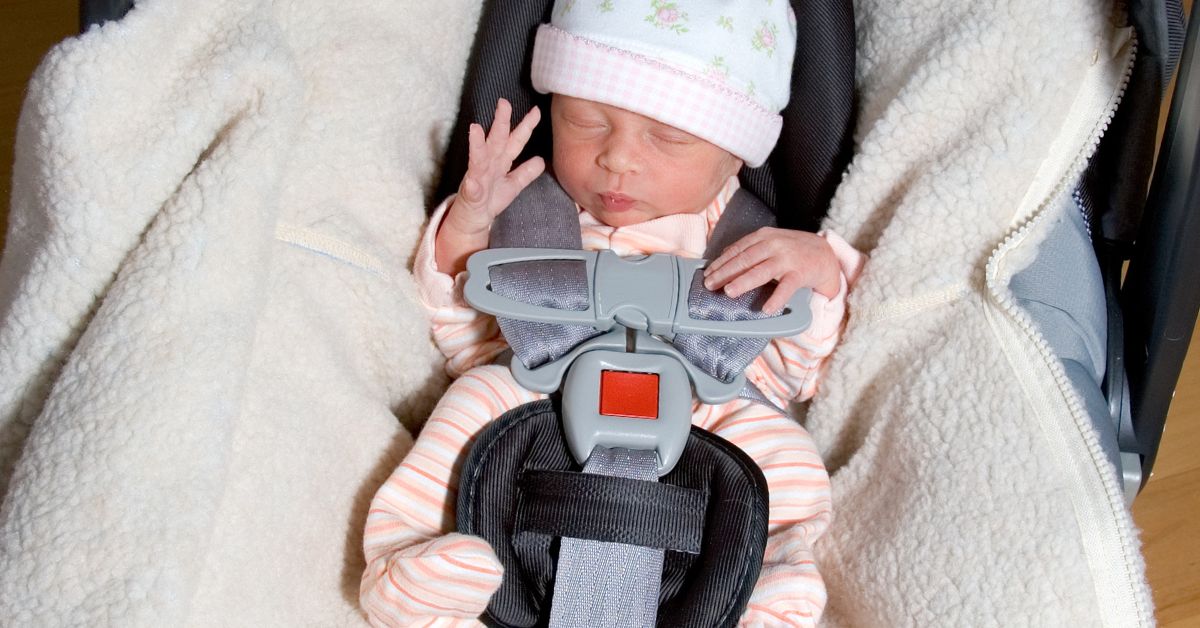
- Avoid using puffy coats, buntings or snowsuits in the car seat. These compress in an accident, leaving the harness too loose to be effective. Instead, buckle your baby snugly and layer a warm blanket over the straps.
You might like this article, too: Natural Treatment Of Heat-Related Illnesses In Kids
Car Seat Safety in Cold Weather
One of the most common mistakes I see in winter is placing a bundled baby into a car seat. While it seems logical to keep them warm during travel, bulky clothing and car seats don’t mix. In a collision, the padding in a thick coat or snowsuit compresses instantly, creating dangerous slack in the harness that can cause a baby to slip out or be injured. Additionally, once the car warms up, if your baby is bundled for outdoor conditions, they’ll be prone to overheating.
The safest way to keep your baby warm in the car is to:
- Dress in thin, snug layers (for example, a cotton sleeper and wool or fleece sleeper).
- Secure the car seat harness tightly against their chest – the straps should lie flat with no slack.
- Car seat safety reminder: Avoid puffy coats or snowsuits in the car seat. The padding compresses during an accident, leaving dangerous slack in the harness. Instead, dress your baby in thinner, snug layers, buckle them securely, and then add warmth after buckling by laying a blanket or a specially designed car seat cover over the harness.
As an additional tip, when possible, you can also pre-warm the car for a few minutes before bringing your baby in!
A note on hats, mittens, and socks:
Full term babies don’t need to wear hats indoors (6), and it’s especially important to never put your baby to sleep in a hat. It’s unsafe because hats can slip down over the face and interfere with breathing.
That said, hats are important outdoors on chilly or windy days. Choose one that’s soft, breathable, and covers the ears, but remove it once you’re back inside or in a warm car or store.
The same balance applies to mittens and socks – use them for warmth when it’s cold, but give your baby plenty of barefoot and bare-hand time indoors to support healthy sensory and motor development.
Safe Winter Sleepwear for Babies
Many parents worry most about keeping their baby warm during the nighttime. Here are some tips:
- Dress your baby in a fitted sleeper made from cotton or bamboo.
- Add a wearable blanket (sleep sack) with a TOG rating suited to room temperature (7):
- 1.0 TOG for 69-73°F
- 2.5 TOG for 61-69°F
- 3.5 TOG for below 61°F
- Avoid loose blankets, hats, or extra bedding, which increase suffocation and overheating risks.
If you bedshare, remember that your body heat already keeps your baby warm, so they’ll usually need fewer layers than if they were sleeping separately. In most cases, a light cotton or bamboo sleeper is enough – skip the very thick sleep sacks, which can lead to overheating.
Always follow safe bedsharing guidelines:
- Sleep on a firm mattress (never on a couch or soft surface)
- Keep your blanket below your hips so it can’t cover your baby.
- Your baby’s head and face should stay uncovered at all times.
- Place your baby on their back within the C-curl of your body.
- Keep the room cool, ideally around 65–68°F (18–20°C).
- Avoid alcohol, sedatives, or smoking, as these increase risk.
Because your warmth influences your baby’s body temperature, check their chest or back to be sure they feel warm and dry, not hot or sweaty. Never use hats, thick sleep sacks, or extra blankets while bedsharing.
To learn more, read this article: Co-Sleeping 101: Benefits, Risk Factors, & Safety Guidelines

Is My Baby Too Hot or Too Cold? How to Check Your Baby’s Temperature
Your baby can’t tell you if they’re uncomfortable, but their body will give you clear clues. The most reliable way to check if your baby is too warm or cold is by touching their chest or back – these areas reflect their core warmth. Hands and feet often feel cooler than the rest of the body, even when your baby is perfectly comfortable, so they’re not accurate indicators.
Signs Your Baby Might Be Too Cold:
- Cool chest or back
- Pale or mottled skin
- Fussiness or lethargy
Signs Your Baby Might Be Too Warm:
- Sweaty hairline or neck
- Flushed cheeks
- Fast breathing or restlessness
When in doubt, remove a layer. It’s generally safer for babies to be slightly cool than overheated (8).
If your baby is warm despite being addressed appropriately, and stays warm once you remove a layer, they might have a fever. Read this article to learn more: Fevers 101: Benefits, Home Care Strategies, & When to Medicate
My Top Winter Weather Tips for Babies
Below are some of the tips I’ve learned over the years, both from caring for my own babies and from having the honor to walk alongside so many of you!
- Use natural fibers whenever possible.
- Avoid bulky items in the car seat!
- Bring backups. Keep an extra outfit in your diaper bag; babies can soak through layers faster than you think, and nothing chills a baby faster than wet clothes!
- A baby carrier counts as a layer! Your body creates more warmth than you might expect – be sure to check often for signs of overheating.
- Don’t fear fresh air. Even in cold weather, brief outdoor time with proper clothing supports immune balance, circadian rhythm, and better sleep.
Summary
Keeping your baby warm in cold weather is all about smart-layering. Babies can’t regulate body temperature as efficiently as adults, so they need help staying comfortable without overheating. Focus on natural, breathable fabrics like cotton, bamboo, or merino wool, and dress your baby in thin, adjustable layers rather than thick ones.
It is very important to avoid puffy coats in the car seat, and instead add warmth with a blanket after buckling the harness. Indoors, be sure to skip hats, mittens, and thick socks when the conditions allow so your baby can explore through touch. At night, use a TOG-rated sleep sack instead of loose blankets.
When in doubt, check your baby’s chest or back to gauge warmth, not their hands or feet. It is generally safer for your baby to be slightly cool rather than overheated.
References:
- Nagy, E. (2001). Gender-related differences in rectal temperature in human neonates. Early Human Development, 64(1), 37–43. https://doi.org/10.1016/s0378-3782(01)00169-4
- Roychoudhury, S., & Yusuf, K. (2017). Thermoregulation: Advances in Preterm Infants. NeoReviews, 18(12), e692–e702. https://doi.org/10.1542/neo.18-12-e692
- Bienboire-Frosini C, Wang D, Marcet-Rius M, Villanueva-García D, Gazzano A, Domínguez-Oliva A, Olmos-Hernández A, Hernández-Ávalos I, Lezama-García K, Verduzco-Mendoza A, Gómez-Prado J, Mota-Rojas D. The Role of Brown Adipose Tissue and Energy Metabolism in Mammalian Thermoregulation during the Perinatal Period. Animals (Basel). 2023 Jul 1;13(13):2173. doi: 10.3390/ani13132173. PMID: 37443971; PMCID: PMC10339909.
- Bigelow AE, Power M. Mother-Infant Skin-to-Skin Contact: Short- and Long-Term Effects for Mothers and Their Children Born Full-Term. Front Psychol. 2020 Aug 28;11:1921. doi: 10.3389/fpsyg.2020.01921. PMID: 32982827; PMCID: PMC7485314.
- Ludington-Hoe SM, Lewis T, Morgan K, Cong X, Anderson L, Reese S. Breast and infant temperatures with twins during shared Kangaroo Care. J Obstet Gynecol Neonatal Nurs. 2006 Mar-Apr;35(2):223-31. doi: 10.1111/j.1552-6909.2006.00024.x. PMID: 16620248; PMCID: PMC1890034.
- Lazzeri J, Giordano NA, Christ L, Polomano RC, Stringer M. Hats Off for Full-Term Healthy Newborns: No Benefits for Thermoregulation. J Perinat Neonatal Nurs. 2023 Oct-Dec 01;37(4):340-347. doi: 10.1097/JPN.0000000000000758. Epub 2023 Sep 28. PMID: 37773332.
- Nhswebsite. (2023, June). Baby safer sleep advice – Best Start in Life – NHS. Nhs.uk. https://www.nhs.uk/best-start-in-life/baby/baby-basics/newborn-and-baby-sleeping-advice-for-parents/safe-sleep-advice-for-babies/
- Williams SM, Taylor BJ, Mitchell EA. Sudden infant death syndrome: insulation from bedding and clothing and its effect modifiers. The National Cot Death Study Group. Int J Epidemiol. 1996 Apr;25(2):366-75. doi: 10.1093/ije/25.2.366. PMID: 9119562.