Because psoriasis can resemble eczema, fungal infections, or simple dry skin, it is often misunderstood. In this article, we’ll walk through what psoriasis is, how it presents in children, common triggers, conventional treatment options, and ways to support your child’s skin and immune system more holistically.
Important note: This article is educational and not medical advice. If you suspect psoriasis, it’s important to seek a clear diagnosis from your pediatrician or dermatologist, as treatment varies depending on type and location.
What Is Psoriasis?
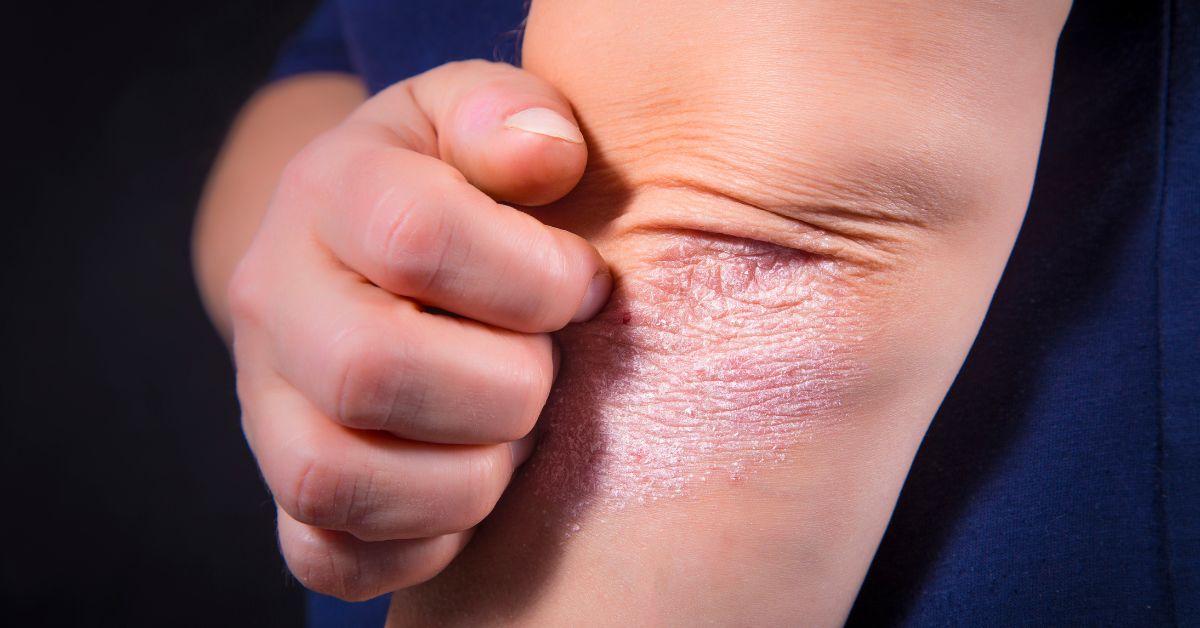
Psoriasis is a chronic inflammatory skin condition driven by immune signaling that speeds up the skin’s growth cycle. Instead of skin cells maturing and shedding gradually, the skin turns over too quickly (1). The result is a buildup of cells on the surface that may look like:
- Thickened plaques
- Scale (often silvery/white on top)
- Redness or darker discoloration depending on skin tone
- These areas may also be itchy
Psoriasis is not contagious. Your child cannot “catch it” from someone else and cannot spread it to siblings.
Psoriasis vs. Eczema: What’s the Difference?
Psoriasis and eczema can sometimes look alike, but both their appearance and what’s driving them underneath the skin are different.
Psoriasis is an immune-driven condition. The immune system sends signals that cause the skin to grow and turn over too quickly (1). Skin cells build up instead of shedding normally, which leads to thicker, well-defined plaques with noticeable scale. It’s commonly seen on the scalp, elbows, knees, or lower back, and can sometimes affect the nails.
Eczema, on the other hand, starts more with a weakened skin barrier. The skin doesn’t hold moisture well and is easily irritated by things like allergens, weather, fabrics, or stress. The rash is often more diffuse, intensely itchy, and commonly appears in skin creases (2). In active flares, it may look red, inflamed, or even slightly oozing.
A helpful way to think about it:
Psoriasis = Immune signals making skin grow too fast.
Eczema = Sensitive skin that overreacts when the barrier is weak.
Because the “why” behind the rash is different, treatment approaches can differ too, which is why the right diagnosis matters.
To learn more about eczema, read this article: Eczema Treatment 101
Common Types of Psoriasis in Children
There are different types of psoriasis, and the types most commonly seen in children include (3):
Plaque psoriasis
This is the classic form of psoriasis. It’s characterized by thicker plaques with scale, often on the scalp, elbows, knees, trunk, and behind the ears.
Scalp psoriasis
Psoriasis on the scalp can look like severe dandruff, thick scale, or well-defined patches at the hairline. It can also overlap with seborrheic dermatitis.
Guttate psoriasis
Guttate psoriasis often shows up as many small “drop-like” spots on the trunk and limbs, and it commonly appears after an infection like strep throat. In some children it resolves; in others, it becomes recurrent or evolves into plaque psoriasis.
Inverse psoriasis
Inverse psoriasis tends to occur in skin folds (armpits, groin, under breasts). It may look shiny, red, and irritated with less scale because the area stays moist.
Nail psoriasis
When psoriasis occurs in the nails, it often looks like pitting, thickening, lifting of the nail from the bed, or discoloration.
What Triggers Psoriasis Flares?
Many children who develop psoriasis have an underlying genetic predisposition to the condition. But genetics alone usually aren’t enough to cause visible symptoms. In most cases, something activates the immune system and triggers a flare (4,5).
Psoriasis is an immune-mediated condition. The immune system sends inflammatory signals that speed up skin cell growth. When the immune system is stimulated – for example by infection, stress, or skin injury – those signals can intensify, and the skin responds with increased inflammation and scale.
- Illness and infections, especially strep throat (a classic trigger for guttate psoriasis)
- Stress and major life changes
- Skin injury (scratches, friction, sunburn) – the Koebner phenomenon (psoriasis appearing where skin is injured) (4)
- Certain medications (this is very individualized; your child’s clinician can help review risks)
- Puberty/hormonal shifts (a common timing for onset or worsening)
How Is Psoriasis Diagnosed?
Often, psoriasis can be diagnosed by a clinician based on the appearance and distribution of the rash. Sometimes a dermatologist will recommend a skin scraping (to rule out fungus) or a biopsy if the pattern is unclear (6).
Psoriasis can usually be managed calmly, and its treatment is rarely urgent, but certain situations deserve quicker evaluation:
- Your child has joint pain, morning stiffness, swelling, or limping (possible psoriatic arthritis)
- There are widespread painful areas, significant skin tenderness, or fever
- Pus-filled lesions (possible pustular psoriasis) or rapidly worsening redness over large areas
- The rash is affecting sleep, mood, school functioning, or quality of life
- You’re not sure if it’s psoriasis (because fungal infections can mimic it)
To learn about fungal skin infections, read these articles:
Conventional Treatment Options for Pediatric Psoriasis
Treatment options for psoriasis depend on location, severity, and how much of the body is affected. Most children start with topical therapy, and many do very well with that.
1) Topical moisturizers and skin-barrier support
Even though psoriasis is immune-driven, skin barrier support matters. Regular emollients can reduce itch, cracking, and the “reactivity” of skin.
2) Topical corticosteroids
Topical steroids are commonly used for psoriasis flares in children, but they should be used carefully, especially high-potency products in sensitive areas. Many pediatric uses are off-label and require thoughtful dosing and follow-up.
Key safety tips: location + potency + duration matter. Face, groin, and skin folds are more prone to side effects, so treatment plans often differ there.
To learn more, read this article: What Parents Need To Know About Steroid Creams For Eczema In Kids
3) Vitamin D analog creams (calcipotriol / calcitriol)
These topicals help slow excessive skin cell turnover and are frequently used alone or alongside topical steroids (8). They can be very helpful for plaque psoriasis, with body-site precautions.
4) Topical calcineurin inhibitors (tacrolimus / pimecrolimus)
These are often used off label for psoriasis in face/genital areas or other sensitive locations where long-term steroid use is more concerning (9).
5) Phototherapy (narrowband UVB)
For more widespread disease, phototherapy can be an effective non-systemic option, typically supervised by dermatology (10).
6) Systemic medications and biologics (for severe cases)
When psoriasis is extensive or significantly impacts quality of life, dermatologists may consider systemic treatments (like methotrexate) or biologics (11). Pediatric biologic options have expanded over recent years.
Because these medications work by suppressing or modifying parts of the immune system, they can increase susceptibility to infections and may require regular laboratory monitoring.
Long-term safety data in children continue to evolve, so families should have thorough discussions about potential benefits, risks, and monitoring requirements before starting therapy.
An Integrative Support For Psoriasis
Many families find that when they reduce inflammatory load and support resilience, flares become less frequent and less intense.
Support the skin barrier gently (every day, not just during flares)
- Keep baths/showers warm (not hot) and shorter.
- Use fragrance-free, gentle cleansers.
- Moisturize right after bathing to lock in hydration.
Focus on anti-inflammatory basics
- Emphasize whole foods: protein, colorful produce, legumes, healthy fats.
- Prioritize omega-3 (fatty fish, supplementation).
- Ensure adequate sleep!
- Get plenty of outside time and movement.
Consider vitamin D status
Vitamin D is relevant to immune balance and skin health (12). Ensure optimal intake through diet, sun exposure, and supplementation.
Manage stress and nervous system support
Stress is a recognized trigger for psoriasis flares. For kids, “stress” can look like:
- Busy schedules and overstimulation
- Social pressure and school overwhelm
- Big emotions with limited tools to process them
Simple daily supports (movement, outdoor time, predictable routines, calming bedtime rhythm) can make a meaningful difference.
To learn more, read this article: Stress Relief For Kids
Reduce friction and micro-injury
Because psoriasis can appear where skin is repeatedly irritated, pay attention to:
- Tight waistbands
- Scratchy clothing
- Sports gear rubbing the same spots
- Habitual picking/scratching
This is especially relevant for scalp psoriasis and plaques in friction zones.
Summary
Psoriasis in children is a chronic, immune-driven inflammatory condition that speeds up skin cell turnover, leading to plaques, scale, and irritation. Flares are often triggered by infections (especially strep), stress, and skin injury. Many children do well with topical support like moisturizers and cautious short-term steroid use when appropriate. For more extensive psoriasis, phototherapy and systemic options — including biologics — may be considered with pediatric dermatology.
Additional support may look like strengthening the skin barrier, identifying trigger patterns, reducing inflammatory burden through nutrition and lifestyle, supporting vitamin D status when needed, and helping a child’s nervous system feel safe and regulated.
References:
- Nair PA, Badri T. Psoriasis. [Updated 2023 Apr 3]. In: StatPearls [Internet]. Treasure Island (FL): StatPearls Publishing; 2025 Jan-. Available from: https://www.ncbi.nlm.nih.gov/books/NBK448194/
- Nemeth V, Syed HA, Evans J. Eczema. [Updated 2024 Mar 1]. In: StatPearls [Internet]. Treasure Island (FL): StatPearls Publishing; 2025 Jan-. Available from: https://www.ncbi.nlm.nih.gov/books/NBK538209/
- Sarac G, Koca TT, Baglan T. A brief summary of clinical types of psoriasis. North Clin Istanb. 2016 Jun 14;3(1):79-82. doi: 10.14744/nci.2016.16023. PMID: 28058392; PMCID: PMC5175084.
- Sanchez DP, Sonthalia S. Koebner Phenomenon. [Updated 2022 Nov 14]. In: StatPearls [Internet]. Treasure Island (FL): StatPearls Publishing; 2025 Jan-. Available from: https://www.ncbi.nlm.nih.gov/books/NBK553108/
- Liu S, He M, Jiang J, Duan X, Chai B, Zhang J, Tao Q, Chen H. Triggers for the onset and recurrence of psoriasis: a review and update. Cell Commun Signal. 2024 Feb 12;22(1):108. doi: 10.1186/s12964-023-01381-0. PMID: 38347543; PMCID: PMC10860266.
- Kim WB, Jerome D, Yeung J. Diagnosis and management of psoriasis. Can Fam Physician. 2017 Apr;63(4):278-285. PMID: 28404701; PMCID: PMC5389757.
- Del Rosso JQ. Topical Corticosteroid Therapy for Psoriasis-A Review of Clobetasol Propionate 0.025% Cream and the Clinical Relevance of Penetration Modification. J Clin Aesthet Dermatol. 2020 Feb;13(2):22-29. Epub 2020 Feb 1. PMID: 32308782; PMCID: PMC7158910.
- Staberg B, Roed-Petersen J, Menné T. Efficacy of topical treatment in psoriasis with MC903, a new vitamin D analogue. Acta Derm Venereol. 1989;69(2):147-50. PMID: 2564233.
- Gutfreund K, Bienias W, Szewczyk A, Kaszuba A. Topical calcineurin inhibitors in dermatology. Part I: Properties, method and effectiveness of drug use. Postepy Dermatol Alergol. 2013 Jun;30(3):165-9. doi: 10.5114/pdia.2013.35619. Epub 2013 Jun 20. PMID: 24278069; PMCID: PMC3834721.
- Zhang P, Wu MX. A clinical review of phototherapy for psoriasis. Lasers Med Sci. 2018 Jan;33(1):173-180. doi: 10.1007/s10103-017-2360-1. Epub 2017 Oct 24. PMID: 29067616; PMCID: PMC5756569.
- Boffa MJ, Chalmers RJ. Methotrexate for psoriasis. Clin Exp Dermatol. 1996 Nov;21(6):399-408. doi: 10.1111/j.1365-2230.1996.tb00142.x. PMID: 9167333.
- Karampinis E, Goudouras G, Ntavari N, Bogdanos DP, Roussaki-Schulze AV, Zafiriou E. Serum vitamin D levels can be predictive of psoriasis flares up after COVID-19 vaccination: a retrospective case control study. Front Med (Lausanne). 2023 May 25;10:1203426. doi: 10.3389/fmed.2023.1203426. PMID: 37305120; PMCID: PMC10247973.