Mononucleosis (most often called mono but sometimes called “the kissing disease”) is a common viral illness. Mono is sometimes brushed off as “just a virus,” but that can undersell how much it can affect a child or teen.
This article shares what mononucleosis is, how it spreads, common symptoms to watch for, and what supportive care and recovery typically look like.
What Is Mononucleosis?
Mononucleosis is most commonly caused (85-90% of the time) by the Epstein-Barr virus (EBV), a very common virus in the herpesvirus family. Most people are exposed to EBV at some point in childhood or adolescence (1).
Less commonly, mononucleosis-like illness can also be caused by other infections, such as cytomegalovirus (CMV). In this article, we’ll primarily focus on EBV, since it is by far the most frequent cause.
It’s important to understand that mononucleosis is not a virus itself. Rather, it’s the name used to describe a specific cluster of symptoms that occur when the immune system mounts a strong response to certain infections, most commonly Epstein-Barr virus (2). In other words, EBV is the virus, while “mono” refers to how the body reacts to that infection. This is why some people can have EBV with few or no symptoms, while others develop full mononucleosis syndrome.
How Is Mononucleosis Spread? (It’s Not Just Through Kissing)
Mononucleosis itself isn’t spread, but rather the virus that causes mononucleosis is spread. Epstein-Barr virus is spread through saliva, which is why mononucleosis is often referred to as “the kissing disease.” However, kissing is only one possible route of transmission.
Epstein-Barr virus can also spread through (1,2):
- Sharing drinks, utensils, or straws
- Close household contact
- Close contact among peers, especially children and adolescents
Because EBV is so widespread and can be shed intermittently, families are rarely able to pinpoint exactly when or how exposure occurred.
You might like this article, too: Does My Child Get Sick Too Often? Understanding Sickness Frequency in Children
Common Symptoms of Mononucleosis
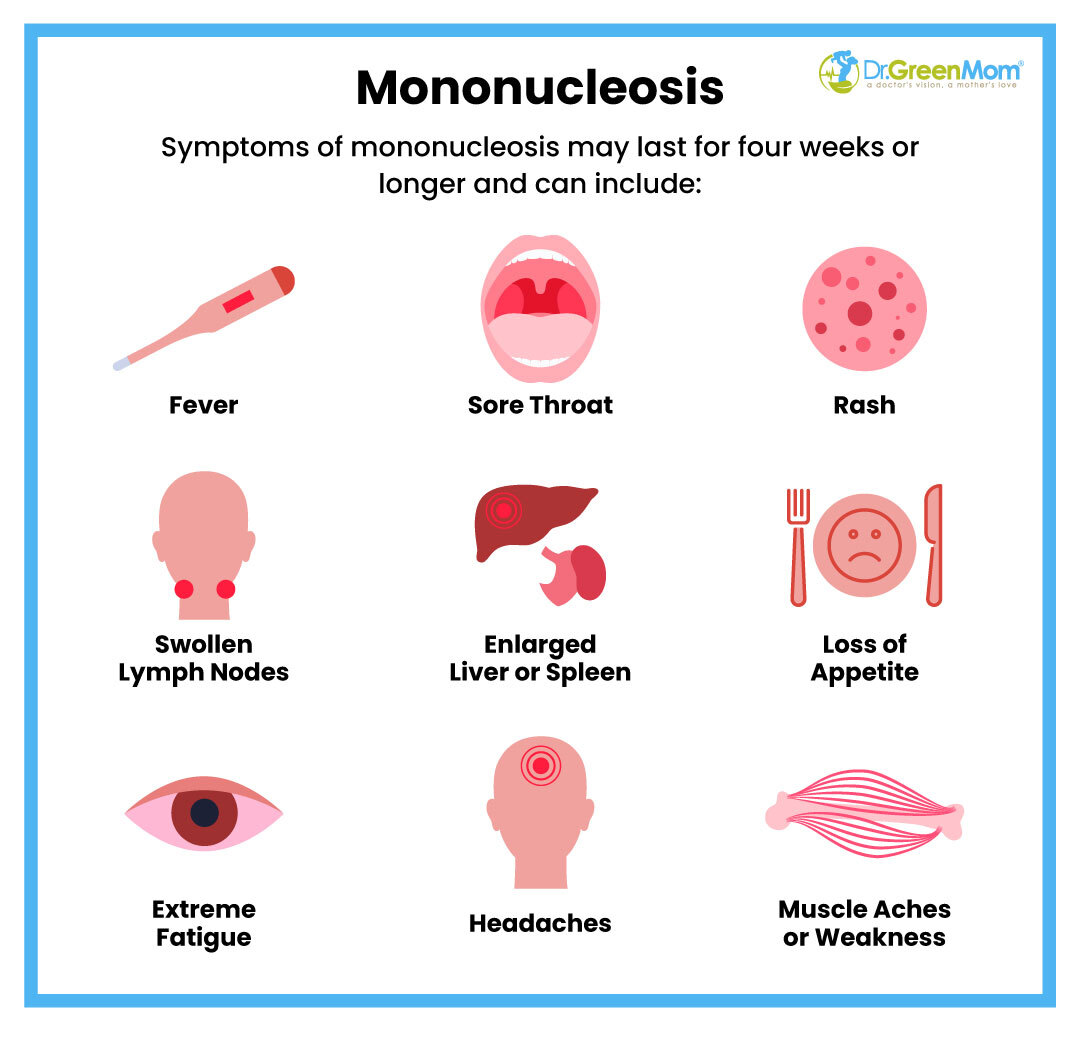
Because mononucleosis refers to a specific symptom pattern caused by the immune response, it’s important to understand what these symptoms are. They can vary, but commonly include:
- Significant fatigue
- Sore throat (sometimes severe)
- Fever
- Swollen lymph nodes, particularly in the neck
- Headache and body aches
- Enlarged tonsils
- Decreased appetite
Some people who come down with mononucleosis may also develop temporary enlargement of the liver and/or spleen, which reflects how actively the immune system is working during infection. This is one reason providers may recommend activity restrictions for a period of time, even after a child starts to feel better – especially for activities that involve contact, impact, or heavy exertion because an enlarged spleen or liver is more vulnerable to injury during this window of recovery (1).
One of the most defining features of mono is that fatigue often lingers. Energy levels may take weeks, and occasionally longer, to fully return, even after other symptoms improve.
Mononucleosis at Different Ages
Age often plays a role in how mono presents itself. In young children, primary Epstein-Barr virus (EBV) infection is often asymptomatic or looks like a routine viral illness, so it may not be recognized as mono. In adolescents and young adults, EBV more often causes the classic mononucleosis syndrome, and recovery can be slower than with typical viral infections, sometimes taking weeks, with fatigue lingering longer. In older adults, EBV infection may present less “classic” and can be harder to recognize, so it may be mistaken for other causes of prolonged fatigue or viral-like illness (3).
Diagnosis and Co-Occurring Infections
Mono is typically diagnosed based on a child’s symptoms along with blood tests that look for antibodies to Epstein-Barr virus (EBV) and characteristic changes in immune cells. Early in the illness, testing may be inconclusive, which is why diagnosis is sometimes made clinically and confirmed later.
It’s also important to understand that co-occurring infections are relatively common during mono. When the body is actively fighting EBV, a large portion of the immune system’s resources are focused on that response. During this time, the immune system may be less efficient at keeping other pathogens in check.
Because of this temporary immune strain, children and teens with mono are more susceptible to secondary infections, most commonly bacterial throat infections such as strep. In these cases, antibiotics may be appropriately prescribed, not to treat EBV itself, but to address the confirmed bacterial infection occurring alongside it.
This distinction matters, because mono stems from viral illness, and antibiotics are not helpful unless a bacterial infection is clearly identified.
To learn more, read this article: When Antibiotics Are Needed & How to Care for Your Microbiome
Rashes During Mononucleosis
Viral rashes are common during mononucleosis. You might notice a widespread pink or red rash made up of small flat or slightly raised spots, often appearing on the trunk and spreading outward. These rashes occur because the immune system is highly activated during EBV infection and can temporarily react in visible ways through the skin.
If your child needs antibiotics for a confirmed bacterial infection while also sick with mononucleosis, they may develop a mild rash after starting the medication. Try not to panic – this is a well-recognized reaction, especially with antibiotics like amoxicillin. It often happens because the immune system is extra reactive during an active EBV infection, rather than because of an immediate drug allergy (4).
In many cases, the rash is temporary and does not mean your child will need to avoid that antibiotic long-term. That said, research shows that some children can develop true sensitivity, which is why it’s important to document the reaction and discuss follow-up with your healthcare provider.
To learn more, read this article: Viral Exanthem Rashes In Children
Mononucleosis Treatment and Supportive Care
There is no medication that cures mono. Treatment focuses on supportive care while the immune system clears the infection.
This generally includes:
- Prioritizing sleep and downtime
- Staying well hydrated
- Eating nutrient-dense, easy-to-digest foods
- Gradually returning to activity rather than rushing
Mono tends to resolve on its own, but it does best when the body is allowed to recover fully.

In some cases:
- Steroids may be used if lymph nodes or tonsils become very swollen.
- IV fluids may be needed if a child is unable to stay hydrated due to throat pain, fever, or exhaustion.
These interventions are not routine but may be appropriate in more severe cases.
Tip: Popsicles are a great way to keep hydrated when a sore throat makes it hard to drink enough!
Herbs For Support During Mononucleosis
Based on the research and traditional use, the following herbs are often chosen for supportive care during mononucleosis:
Licorice root
Licorice contains plant compounds that have been widely studied in laboratory research (5). In clinical and traditional use, licorice is commonly included in formulas designed to support immune system balance and throat comfort.
Green tea–derived compounds (EGCG)
Green tea contains natural plant compounds, including EGCG, known for their antioxidant properties. It can be a gentle way to support the body during times of increased demand, with a mild, natural energy lift (6).
Astragalus
Astragalus is traditionally used to support immune resilience and recovery (7), especially during times of prolonged fatigue or stress.
Elderberry
Elderberry and other deeply pigmented plants provide polyphenols that support antioxidant balance and overall immune wellness (8).
Other ways to use herbs during mononucleosis infection is for symptom management, with herbal support offering a gentle way to support discomfort.
When to Call the Doctor About Mononucleosis
If you suspect you or your child may have mono, it’s important to get evaluated by a doctor. You should also contact your healthcare provider if:
- Symptoms worsen or don’t improve
- Swelling makes swallowing or breathing difficult
- Abdominal pain develops
- Fever persists
- Fatigue is very severe or prolonged
- Something feels off
While mono is usually self-limiting, complications should always be evaluated.
If you have a child or young adult who is moving into a college or residential school setting for the first time:
Shared living spaces can increase exposure to common viruses, and it’s not uncommon for mononucleosis to spread quickly through college dorms. Below are some tips to help equip your teen or young adult:
- Check iron, vitamin B12, and vitamin D status ahead of time and address any deficiencies with a healthcare provider.
- Remind them not to share drinks, utensils, water bottles, or straws.
- Encourage them not to push through illness and to prioritize rest, medical care, or coming home if they’re not feeling well.
- Talk openly about sleep and stress, and emphasize that chronic sleep deprivation can make it harder for the immune system to recover.
- Encourage good hydration and regular meals, especially during busy or stressful periods.
- Remind them to seek medical evaluation for prolonged fatigue, sore throat, or swollen glands rather than assuming it’s “just stress.”
- Normalize asking for academic accommodations if they are sick. Resting is part of recovery, not a failure.
Summary
Mononucleosis (mono) is a common illness most often caused by the Epstein–Barr virus (EBV). While many children experience mild or even unnoticed infections, teens and young adults are more likely to develop the classic symptoms – significant fatigue, sore throat, fever, and swollen lymph nodes. Recovery can take quite a bit longer than a typical virus, often unfolding over weeks, which is why rest, patience, and supportive care are so important during this time.
References:
- Mohseni M, Boniface MP, Graham C. Mononucleosis. [Updated 2023 Aug 8]. In: StatPearls [Internet]. Treasure Island (FL): StatPearls Publishing; 2025 Jan-. Available from: https://www.ncbi.nlm.nih.gov/books/NBK470387/
- Dunmire SK, Hogquist KA, Balfour HH. Infectious Mononucleosis. Curr Top Microbiol Immunol. 2015;390(Pt 1):211-40. doi: 10.1007/978-3-319-22822-8_9. PMID: 26424648; PMCID: PMC4670567.
- Skenderi, Elda & Kuli-Lito, Gjeorgjina. (2017). CLINICAL SPECTRUM OF INFECTIOUS MONONUCLEOSIS IN CHILDREN. 763-770.
- Ónodi-Nagy K, Kinyó Á, Meszes A, Garaczi E, Kemény L, Bata-Csörgő Z. Amoxicillin rash in patients with infectious mononucleosis: evidence of true drug sensitization. Allergy Asthma Clin Immunol. 2015 Jan 9;11(1):1. doi: 10.1186/1710-1492-11-1. PMID: 25784943; PMCID: PMC4362637.
- Lin JC, Cherng JM, Hung MS, Baltina LA, Baltina L, Kondratenko R. Inhibitory effects of some derivatives of glycyrrhizic acid against Epstein-Barr virus infection: structure-activity relationships. Antiviral Res. 2008 Jul;79(1):6-11. doi: 10.1016/j.antiviral.2008.01.160. Epub 2008 Mar 31. PMID: 18423902; PMCID: PMC7114209.
- Xu J, Xu Z, Zheng W. A Review of the Antiviral Role of Green Tea Catechins. Molecules. 2017 Aug 12;22(8):1337. doi: 10.3390/molecules22081337. PMID: 28805687; PMCID: PMC6152177.
- Guo Q, Sun X, Zhang Z, Zhang L, Yao G, Li F, Yang X, Song L, Jiang G. The effect of Astragalus polysaccharide on the Epstein-Barr virus lytic cycle. Acta Virol. 2014;58(1):76-80. doi: 10.4149/av_2014_01_76. PMID: 24717032.
- Chojnacka K, Skrzypczak D, Izydorczyk G, Mikula K, Szopa D, Witek-Krowiak A. Antiviral Properties of Polyphenols from Plants. Foods. 2021 Sep 26;10(10):2277. doi: 10.3390/foods10102277. PMID: 34681326; PMCID: PMC8534698.